
 Image 1 of 1
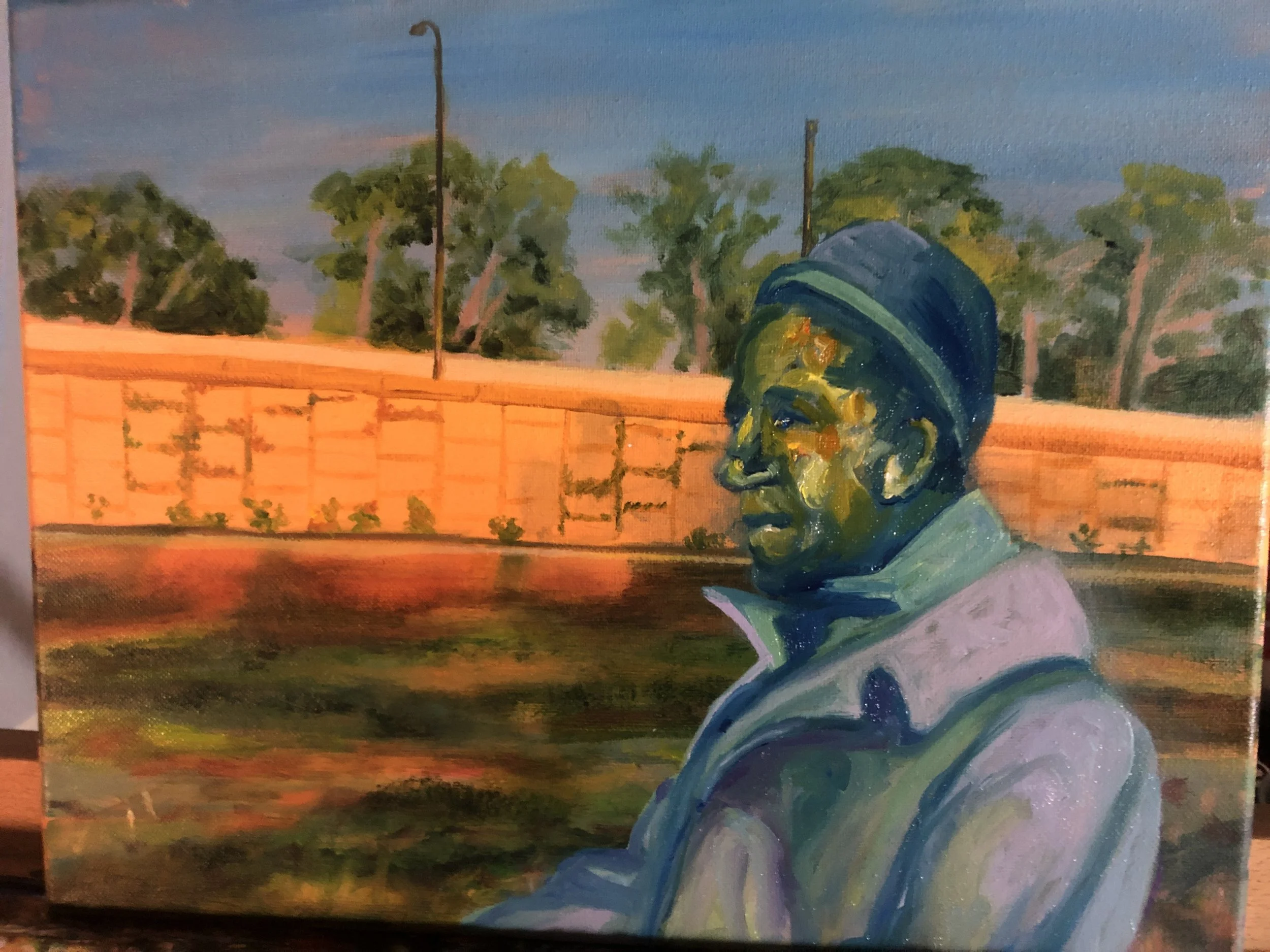
Original Oil on Canvas
12”x14”
Beauford Delaney (1901-1979) was a prominent Black American artist who was good friends with James Baldwin. I am deeply impacted by his work, particularly his color-filled portraits of his contemporaries. The background is an older painting I did of a highway ramp with weeds growing in the cracks. Baldwin spoke of Delaney:
“He was then . . . working all the time, or perhaps it would be more accurate to say that he was seeing all the time; and the reality of his seeing caused me to begin to see. . . . What I saw, first of all, was a brown leaf on black asphalt, oil moving like mercury in the black water of the gutter, grass pushing itself up through a crevice in the sidewalk. And because I was seeing it with Beauford, because Beauford caused me to see it, the very colors underwent a most disturbing and salutary change. The brown leaf on the black asphalt, for example—what colors were these, really? To stare at the leaf long enough, to try and apprehend the leaf, was to discover many colors in it; and though black had been described to me as the absence of light, it became very clear to me that if this were true, we would never have been able to see the color, black: the light is trapped in it and struggles upward, rather like that grass pushing upward through the cement.”
Original Oil on Canvas
12”x14”
Beauford Delaney (1901-1979) was a prominent Black American artist who was good friends with James Baldwin. I am deeply impacted by his work, particularly his color-filled portraits of his contemporaries. The background is an older painting I did of a highway ramp with weeds growing in the cracks. Baldwin spoke of Delaney:
“He was then . . . working all the time, or perhaps it would be more accurate to say that he was seeing all the time; and the reality of his seeing caused me to begin to see. . . . What I saw, first of all, was a brown leaf on black asphalt, oil moving like mercury in the black water of the gutter, grass pushing itself up through a crevice in the sidewalk. And because I was seeing it with Beauford, because Beauford caused me to see it, the very colors underwent a most disturbing and salutary change. The brown leaf on the black asphalt, for example—what colors were these, really? To stare at the leaf long enough, to try and apprehend the leaf, was to discover many colors in it; and though black had been described to me as the absence of light, it became very clear to me that if this were true, we would never have been able to see the color, black: the light is trapped in it and struggles upward, rather like that grass pushing upward through the cement.”